Healthcare providers renewing their Basic Life Support (BLS) certification in 2026 may encounter several changes based on the American Heart Association’s (AHA) 2025 CPR and Emergency Cardiovascular Care guidelines. These updates affect how rescuers respond to choking emergencies, perform infant chest compressions, and address suspected opioid-related emergencies.
For professionals who learned BLS several years ago, reviewing these changes before a renewal course can help them understand current recommendations and prepare for practical skills assessments.
1. Updated Procedures for Choking Emergencies
One notable change involves the management of foreign-body airway obstruction (FBAO). Under the 2025 guidelines, the recommended response for a conscious adult with severe airway obstruction is to alternate five back blows with five abdominal thrusts. Previously, training commonly emphasized abdominal thrusts first.
The updated approach also applies to children with severe airway obstruction. For infants, rescuers should alternate five back blows with five chest thrusts instead. Abdominal thrusts are not recommended for infants because of the risk of injury to their internal organs.
If an individual becomes unresponsive, rescuers should initiate CPR, beginning with chest compressions, and check for a visible foreign object when opening the airway to provide breaths. These distinctions are important because the correct response depends on the patient’s age and condition.
2. Changes to Infant Chest Compression Techniques
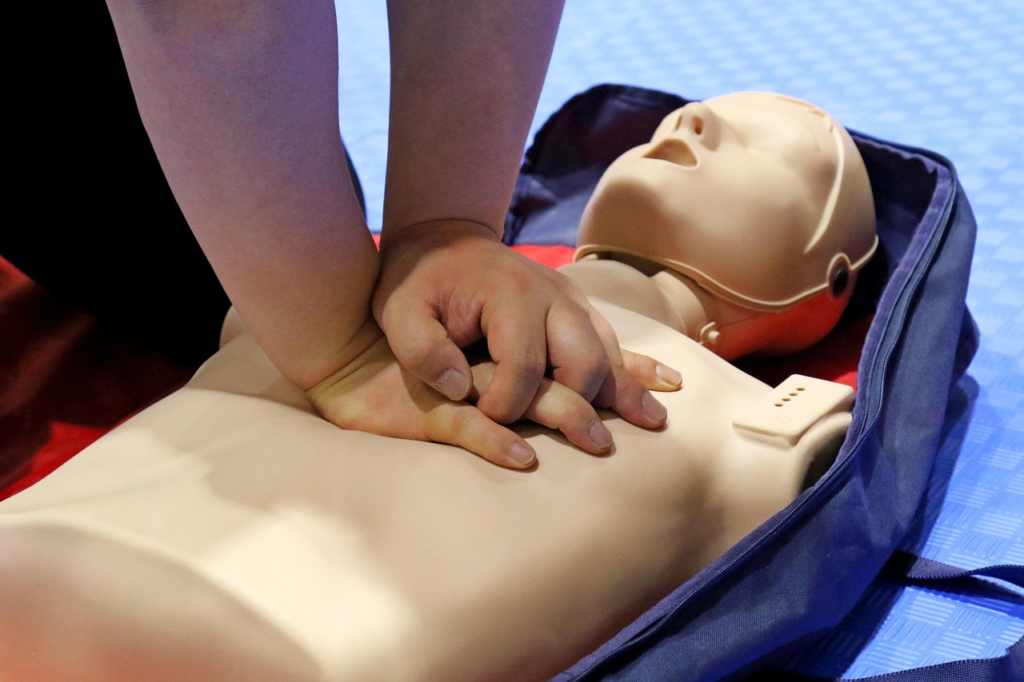
Healthcare providers who learned infant CPR under earlier guidelines should pay attention to the revised compression techniques. The 2025 AHA guidelines no longer recommend the two-finger technique for infant chest compressions. Instead, rescuers should use either the heel of one hand or the two-thumb, encircling-hands technique. If the rescuer cannot physically encircle the infant’s chest, the heel-of-one-hand technique is recommended.
This change reflects concerns about the two-finger technique’s ability to achieve adequate compression depth. During training, healthcare professionals should practise the recommended techniques and understand when each is appropriate. The guidelines also emphasize minimizing interruptions in CPR for infants and children, with pauses in chest compressions kept under 10 seconds.
3. Naloxone in the Adult BLS Algorithm
The updated adult BLS algorithm incorporates opioid antagonists, such as naloxone, into the response to suspected opioid-related respiratory or cardiac arrest. This addition reflects the importance of recognizing possible opioid involvement during an emergency. However, naloxone does not replace standard resuscitation measures.
Healthcare providers should continue to prioritize appropriate CPR, ventilation, emergency response activation, and AED use according to the patient’s condition and current protocols. Understanding where naloxone fits into the response helps providers recognize that managing a suspected opioid-related emergency may require additional interventions alongside established BLS measures.
At CPR, ACLS & PALS Training Institute, we offer American Heart Association-approved courses with hands-on practice and qualified instructors. If you are searching for BLS certification for healthcare providers or CPR classes near you, we can help you explore the appropriate training option. Serving Philadelphia, Northeast Philadelphia, Bensalem, and surrounding areas, including Bucks and Montgomery Counties and Trenton, New Jersey, we also provide ACLS certification near you for eligible learners.
Contact us to find a course that meets your professional requirements and prepare for your next certification or renewal.